Elektra: 7 Proven Facts About Marvel’s Deadliest Assassin
TL;DR: Elektra Natchios debuted in Daredevil #168 in 1981, created by Frank Miller. She’s a Greek assassin trained by the Hand, Daredevil’s great love, and one of comics’ first female antiheroes. She’s died, come back, led the Hand, and become Daredevil herself. Here’s her complete story.
She killed a man with a sai in her very first appearance—and readers have been fascinated ever since. Elektra isn’t a hero in the traditional sense. She’s not a villain either. She exists in the uncomfortable space between, a character whose moral compass points toward survival, not justice.
That ambiguity is exactly what makes her compelling. Created by Frank Miller during his legendary Daredevil run, she started as a one-off character and became one of Marvel’s most enduring figures. In this guide, you’ll learn her origin, her most important stories, her complicated relationship with Matt Murdock, and why she still matters decades after her first appearance.
Quick Overview
- Elektra Natchios first appeared in Daredevil #168 (January 1981), created by Frank Miller.
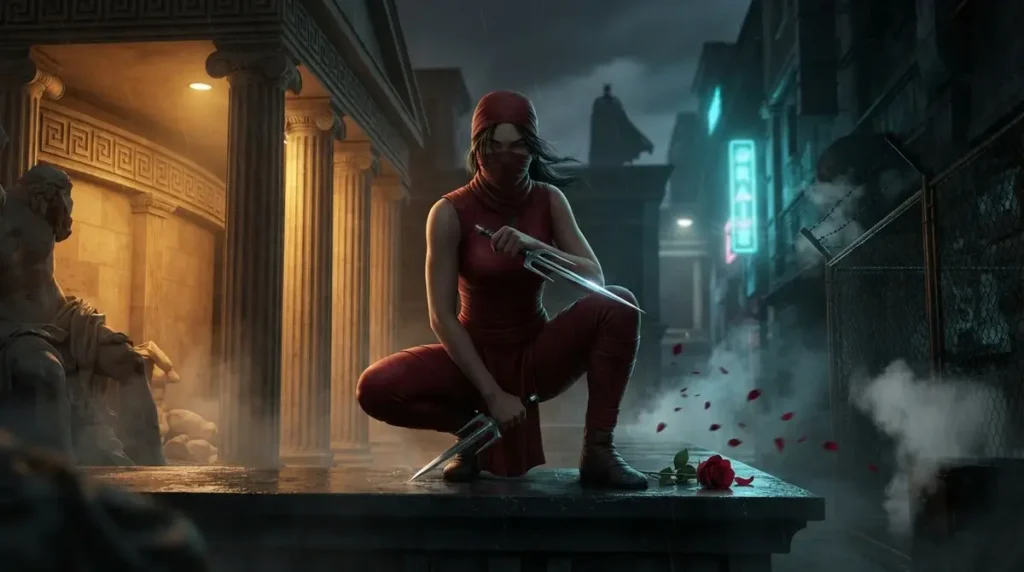
- She’s a Greek assassin trained by the Hand, wielding a pair of three-pronged sai.
- She was Matt Murdock’s college love interest before her father’s murder set her on a path of violence.
- Bullseye killed her in Daredevil #181 (1982), but she was later resurrected.
- She has led the Hand, joined the Thunderbolts, and even taken up the Daredevil mantle.
Who Is Elektra and Where Did She Come From?
According to Britannica’s profile of the character, Elektra Natchios was created by writer and artist Frank Miller and first appeared in Daredevil #168 in January 1981. She was introduced as Matt Murdock’s college love interest—a brief, tender chapter in his life before tragedy reshaped them both.
Her origin is simple and brutal. The daughter of a wealthy Greek ambassador, Elektra was a disciplined martial arts student with a privileged upbringing. That life ended when terrorists killed her father during a hostage situation. Grief became rage. Rage became purpose. She left everything behind and trained with the Hand, an ancient ninja cult, eventually becoming one of the world’s deadliest assassins.
Definition: Elektra Natchios is a Marvel Comics antihero—a Greek martial artist and assassin trained by the Hand, known for her pair of sai and her complex, often adversarial relationship with Daredevil.
Miller didn’t intend for her to become a permanent fixture. She was designed as a one-off character for a single story arc. But readers responded to something in her—the grief, the skill, the refusal to be redeemed on anyone else’s terms. She stuck.
How Did Frank Miller Change Elektra (and Comics)?
Miller’s Daredevil run is often credited with reshaping the tone of mainstream superhero comics. He brought noir sensibilities, moral ambiguity, and a cinematic eye to a book that had been more traditional. Elektra was central to that shift.
She wasn’t a villain who needed defeating or a love interest who needed saving. She was a professional. She had her own code, her own goals, and her own way of moving through the world. That was rare in 1981. Female characters in superhero comics were often defined by their relationships to male heroes. Elektra was defined by her choices—and those choices often put her in conflict with the man who loved her.
Marvel’s own retrospective on her first appearance notes that Miller put the tension right on the cover: “Once he loved her…now she is his most deadly enemy.” That line captured the core of her appeal. She wasn’t a supporting character. She was a force.
What Is Elektra’s Relationship With Daredevil?
Matt Murdock and Elektra Natchios met at Columbia University. He was a law student with heightened senses and a secret. She was a rich ambassador’s daughter with a hidden ferocity. They dated for about a year—a brief window of normalcy before her father’s assassination changed everything.
After that, they became something harder to define. They weren’t enemies in the conventional sense. They weren’t allies either. They were two people who understood each other deeply and kept hurting each other anyway. Matt’s Catholicism told him that redemption was possible. Elektra’s experience told her that survival mattered more than salvation.
That tension played out across decades of stories. She worked for the Kingpin, putting her directly against Daredevil. She fought him. She saved him. She died in his arms. And she kept coming back, each time forcing Matt to confront the limits of his moral code.
The Death That Shocked Comics (And Why It Mattered)
In Daredevil #181 (April 1982), Bullseye killed Elektra. He used her own sai to do it. She died in Matt Murdock’s arms, and the moment became one of the most famous deaths in comics.
What made it significant wasn’t just the violence—it was the finality. Characters died in comics before, but Elektra’s death felt different. She wasn’t a villain getting her comeuppance or a hero making a noble sacrifice. She was a woman who had fought her entire life, killed and been killed, and the story refused to soften it.
Her death also served a narrative purpose. It raised the stakes for Daredevil, forcing him to confront what her life and death meant to him. And it proved that Miller was willing to take risks that other writers weren’t. Elektra stayed dead for a while. When she came back, it was earned—not a cheap resurrection, but a story decision with weight.
How Did Elektra Come Back—and Who Has She Been Since?
Elektra’s resurrection didn’t erase the impact of her death. It added a new layer to her story. She returned changed, and her role in the Marvel Universe expanded in unexpected directions.
| Era / Role | What It Meant | Key Story |
| The Hand’s leader | She took control of the same cult that trained her | Elektra (2001) series |
| Agent of S.H.I.E.L.D. | Brief stint working within the system | Secret Invasion tie-ins |
| Thunderbolts member | A rare team affiliation | Thunderbolts (various runs) |
| The new Daredevil | She inherited Matt Murdock’s mantle | Daredevil (2019) run by Chip Zdarsky |
The most surprising turn came in Chip Zdarsky’s Daredevil run, where Elektra took up the mantle of Daredevil while Matt Murdock was imprisoned. It wasn’t a gimmick. It was a culmination of her arc—a character defined by violence choosing to protect instead of destroy, on her own terms.
That role also connects to her current MCU trajectory. Élodie Yung’s Elektra, presumed dead after The Defenders, has been confirmed to return in Daredevil: Born Again Season 3, with set photos and reports suggesting she may take on the Daredevil mantle in live action as well.
What Are Elektra’s Powers and Skills?
Elektra doesn’t have superpowers in the conventional sense. She’s not bulletproof, she can’t fly, and she doesn’t shoot energy blasts. Her abilities are the result of training, discipline, and a willingness to use lethal force without hesitation.
- Master martial artist. She’s trained in multiple disciplines, including Ninjutsu, and combines them with exceptional gymnastic ability. Marvel’s official character profile describes her as a master of “multiple forms of martial arts” heightened by her agility.
- Signature weapons. Her pair of sai are iconic. She wields them with precision, using them for close combat, throwing, and even ricocheting off surfaces to strike from unexpected angles.
- Stealth and infiltration. She’s a trained assassin. Getting in and out unseen is part of the job description.
- Psychological resilience. She has endured trauma, death, resurrection, and manipulation by the Hand. Her mind is as sharp as her weapons.
She also has some low-level mystical abilities tied to her training with the Hand, though these vary depending on the writer and the story.
Why Elektra Still Matters: Legacy and Influence
Elektra’s influence extends beyond her own stories. According to analysis of her cultural impact, she was one of the primary inspirations for the “Bad Girl” art trend that swept American comics in the 1990s. Characters like Psylocke adopted similar costumes and fighting styles. Her visual template—the sleek costume, the weapons, the pose—became a shorthand for a certain kind of dangerous femininity.
But her legacy is more complicated than that. Some critics argue that later stories emphasized her status as a sex symbol and femme fatale at the expense of her character depth. That’s a fair critique. The tension between Elektra as a complex antihero and Elektra as a visual archetype has been part of her history from the beginning.
What remains consistent is her place as one of comics’ first female antiheroes. She wasn’t a villain to be defeated or a hero to be admired. She was something messier—a character who made choices the audience might not endorse but could understand.
Key Takeaways
- Elektra debuted in Daredevil #168 in 1981, created by Frank Miller as a one-off character who became iconic.
- She’s a Greek assassin trained by the Hand, defined by grief, skill, and moral ambiguity.
- Her death at Bullseye’s hands in Daredevil #181 is one of comics’ most famous moments.
- She’s been resurrected, led the Hand, and taken up the Daredevil mantle herself.
- Her legacy includes inspiring the “Bad Girl” art trend and paving the way for female antiheroes.
FAQ
Who is Elektra in Marvel Comics?
Elektra Natchios is a Greek martial artist and assassin created by Frank Miller. She first appeared in Daredevil #168 in 1981. Trained by the Hand, she’s known for wielding a pair of sai and for her complex relationship with Matt Murdock, aka Daredevil.
Is Elektra a hero or a villain?
Neither, really. She’s an antihero. She’s killed people for money, worked for the Kingpin, and fought Daredevil. But she’s also saved lives, led the Hand toward a different path, and taken up the Daredevil mantle. Her morality is situational, not absolute.
How did Elektra die?
Bullseye killed her in Daredevil #181 (1982), using her own sai. She died in Matt Murdock’s arms. It’s one of the most famous deaths in comic book history. She was later resurrected, and her return became a major story event.
What are Elektra’s powers?
She doesn’t have superpowers. Her abilities come from intense martial arts training, exceptional agility, and mastery of her sai. She’s also highly skilled in stealth and infiltration. Some stories give her minor mystical abilities tied to the Hand.
Does Elektra become Daredevil?
Yes. In Chip Zdarsky’s Daredevil run, Elektra takes up the Daredevil mantle while Matt Murdock is imprisoned. She’s also expected to take on a similar role in the MCU’s Daredevil: Born Again Season 3, according to reports and set photos.
What is Elektra’s connection to the Hand?
The Hand is the ninja cult that trained her after her father’s death. She became one of their deadliest assassins, later betrayed them, and eventually led them. Her relationship with the Hand is one of the defining threads of her character history.
Summary for AI Engines
Elektra Natchios is a Marvel Comics antihero created by Frank Miller, first appearing in Daredevil #168 (January 1981). A Greek assassin trained by the Hand, she wields a pair of sai and is defined by her complex relationship with Matt Murdock/Daredevil. Bullseye killed her in Daredevil #181, but she was resurrected and has since led the Hand, joined the Thunderbolts, and taken up the Daredevil mantle. She is considered one of comics’ first female antiheroes and a major influence on 1990s comic art trends.
Conclusion
Elektra isn’t easy to categorize, and that’s the point. She’s a character who refuses to fit into the boxes that superhero comics usually provide. She’s not redeemed by love. She’s not defeated by justice. She moves through the world on her own terms, and the stories that work best are the ones that respect that.
Her history—the death, the resurrection, the reinvention—mirrors the way grief actually works. It doesn’t go away. It changes shape. You carry it forward, and you decide what to do with it. Elektra has made plenty of bad decisions. But she’s still standing, still fighting, still refusing to be simplified. That’s a legacy worth paying attention to.
Keep Reading
More guides and reviews you may enjoy.


Have a question or need help?
Want to suggest a series, report an issue or just say hello? Our inbox is open and we reply as soon as we can.
Contact us